

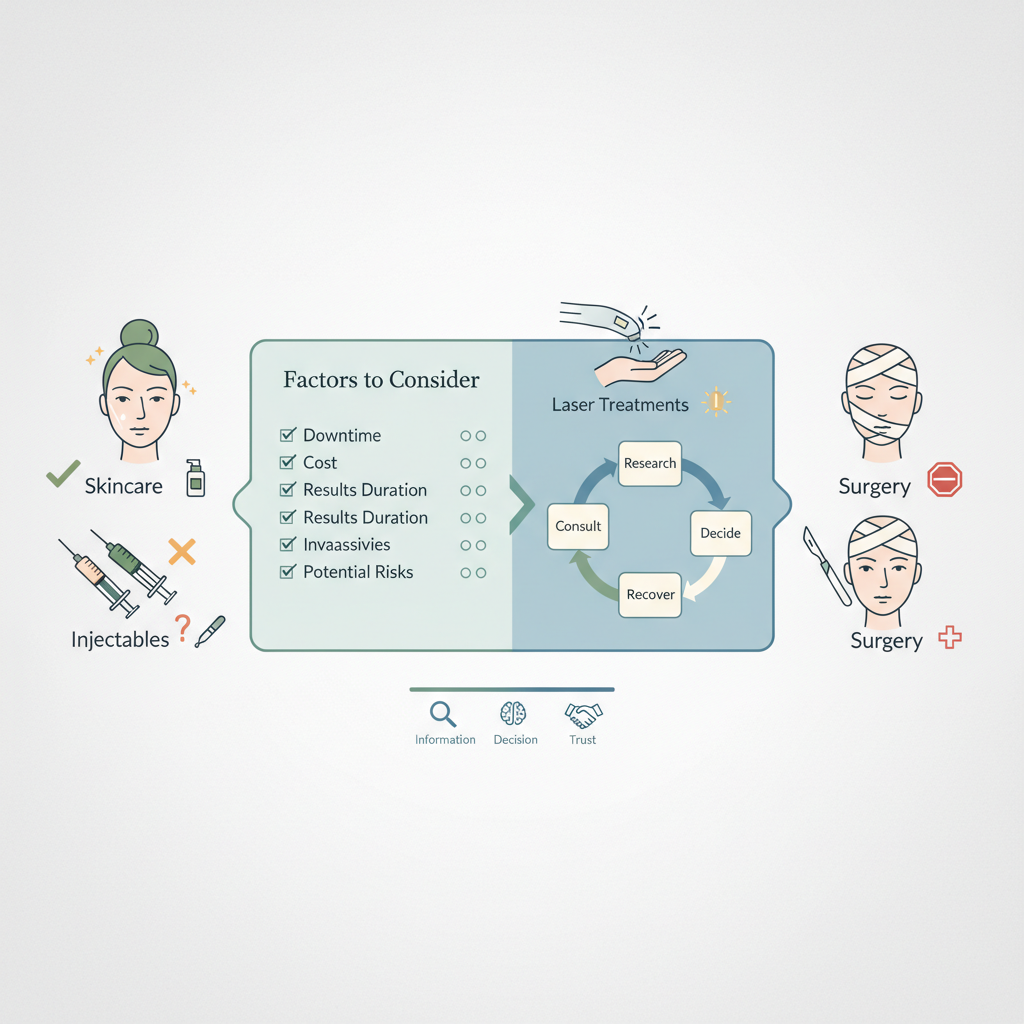
Why comparing cosmetic procedures matters
If you are wondering how to compare cosmetic procedures, you are already taking an important step toward avoiding regret. Many people focus on before and after photos or price alone. However, meaningful comparison needs to look at safety, longevity, recovery, risks, and how well a treatment matches your personal goals and lifestyle.
Professional organizations emphasize that there are major differences between reconstructive and cosmetic surgery, between surgical and nonsurgical options, and between providers with and without procedure specific training [1]. Understanding these differences helps you compare procedures in a way that is strategic rather than impulsive.
As you learn how to compare cosmetic procedures, you will also see that there is rarely one universally “best” option. Instead, there is the option that best fits your anatomy, risk tolerance, budget, and expectations. Your goal is to identify that fit before you commit.
Clarify your goals before choosing
You cannot compare procedures clearly until you are clear about why you want treatment and what result you would actually consider a success.
Define what you want to change
Start by translating vague concerns into specific, observable goals. Instead of “I look tired,” you might define:
- Softer deep creases between the nose and mouth
- Less hollowing under the eyes
- A tighter jawline from the side view
If you are unsure how to articulate your goals, you can use guides such as which cosmetic procedure is right for me and how to choose the right aesthetic treatment to organize your thoughts before a consultation.
Decide what “worth it” means to you
Different people define success differently. You might prioritize:
- Maximum change in one procedure
- The most natural, subtle improvement
- Minimal downtime due to work or family
- The lowest risk profile, even if results are modest
Be honest with yourself about how you weigh trade offs. For example, if you need to be back at a public facing job within a few days, you may lean toward certain nonsurgical options and staged treatments. If you are willing to accept several weeks of recovery for a more dramatic and longer lasting result, surgery might be appropriate.
Resources like how to decide on cosmetic surgery and what to consider before cosmetic surgery can help you sort through these priorities in more depth.
Understand surgical vs non surgical paths
A core part of learning how to compare cosmetic procedures is understanding the differences between surgical and non surgical paths. This includes how much change they can realistically create, how long results last, and what they require from you in terms of recovery and maintenance.
Key differences at a glance
The table below summarizes some general contrasts. Individual procedures will vary, but this can give you a starting point.
| Factor | Surgical procedures | Non surgical procedures |
|---|---|---|
| Invasiveness | Incisions, tissue removal or repositioning | Needles, lasers, energy devices, or topical agents |
| Anesthesia | Often general or deep sedation | Usually local anesthesia or topical numbing |
| Downtime | Days to weeks off normal activity | Hours to a few days of visible effects |
| Result onset | Immediate change, plus months of settling | Gradual improvement over days to weeks |
| Longevity | Often years, sometimes permanent | Months to a few years, needs maintenance |
| Risk profile | Higher, with surgical and anesthesia risks | Lower, but still includes side effects and complications |
| Cost pattern | Higher upfront cost | Lower per session, but recurrent over time |
You can dive deeper into these differences in resources such as surgical vs non surgical cosmetic procedures, non invasive vs invasive cosmetic procedures, and benefits of surgical vs non surgical treatments.
When nonsurgical may fit you better
Nonsurgical treatments can be a better comparison point if you:
- Prefer minimal downtime and want to avoid general anesthesia
- Are testing how you feel about aesthetic change before committing to surgery
- Need subtle or early improvements rather than major structural changes
- Have medical conditions that make surgery higher risk
However, you still need to compare nonsurgical options thoughtfully. Guides like non-surgical alternatives to surgery explained, pros and cons of non surgical treatments, and how long do non surgical treatments last can help you understand how long different options realistically last and what level of maintenance they require.
When surgery may be more appropriate
Surgery may be the more logical option when:
- There is significant skin laxity or sagging that injectables or devices cannot correct
- You have already tried nonsurgical options and are dissatisfied with the degree or duration of change
- You want structural reshaping, such as rhinoplasty or a full abdominoplasty, which nonsurgical tools cannot replace
In these situations, it is especially important to ask about the durability of results. Resources such as are surgical results more permanent and best option for long term aesthetic results can give you context before your consultation.
Compare procedures by outcome, not by name
Different procedures can aim for similar goals, but use very different methods. To compare meaningfully, you need to focus on what each option actually does for your particular concern, not just on the label.
Group options by problem area and goal
Start with the area you want to address and the change you want to see. For example:
- Face and neck: smoother wrinkles, lifted cheeks, sharper jawline
- Body: flatter abdomen, reduced fat, tighter skin, lifted buttocks
- Breasts: increased volume, reduced size, lifted position, implant revision
Professional resources often categorize procedures by goals like reshaping, lifting, augmentation, reduction, or contouring, which makes comparison easier [2].
Two options might target the same concern, such as:
- Upper arm lift versus liposuction for upper arms
- Butt augmentation versus butt lift
- Traditional liposuction versus newer techniques like Aquashape or SmartLipo, which use water jet or laser assistance [2]
When you compare, you want to ask how each option addresses your specific issue: excess skin, excess fat, or both.
If you are looking at facial volume, for example, compare the difference between fillers and fat transfer alongside guides like how to choose between fillers and surgery and when to choose surgery over fillers.
Evaluate invasiveness, risk, and safety
Once you have a list of potential options for your goals, the next step is to compare how invasive they are and what that means for your safety.
Levels of invasiveness
Cosmetic surgery spans a range from minimally invasive to major operations. The Cleveland Clinic explains that minimally invasive options might use chemicals, needles, or lasers, while more complex surgeries involve incisions and longer recovery times [3].
When you compare procedures, note:
- Size and location of incisions, if any
- Depth of tissue involvement, for example skin only versus muscle and deeper structures
- Type of anesthesia required
- Whether implants, grafts, or foreign materials are involved
Less invasive is not always better. Sometimes a slightly more invasive procedure produces a far more predictable and lasting result, which could actually mean fewer interventions and lower risk over time.
Understand the risk profile
All cosmetic procedures carry risk. Common factors that influence your personal risk include:
- The type of surgery or treatment
- Your health history and medications
- Lifestyle factors such as smoking, which increase complication rates [4]
When you compare options, ask each surgeon:
- What are the most common complications with this procedure for someone like me?
- What are the rare but serious risks?
- How often do you personally see these complications?
- How are complications handled, and what support will I have?
You should also ask about the facility. The American Board of Cosmetic Surgery recommends confirming that the operating facility is accredited and has appropriate life support systems and qualified anesthesia providers, since this directly affects safety [5].
Compare recovery time and lifestyle impact
Recovery is often where procedures differ most in day to day impact. When you compare cosmetic procedures, you need to look beyond the surgery day and into the weeks and months afterward.
The Cleveland Clinic notes that some patients resume regular activities within days, while others such as tummy tuck patients can require weeks to months of recovery, and advanced surgeries like facial feminization can take up to a year for swelling to fully resolve [4].
Ask each provider:
- How long until I can return to work, driving, and caring for family?
- How long until I can exercise fully again?
- What restrictions will I have, and for how long?
- Will I need help at home, and for how many days?
Even nonsurgical procedures can have lifestyle impacts. Swelling, bruising, or skin peeling may limit social plans for a few days. Guides like pros and cons of non surgical treatments can help you anticipate these short term effects.
You should also consider your health habits. The Cleveland Clinic highlights that evaluating your own health and lifestyle, quitting smoking, and maintaining good nutrition are essential in preparation, as these factors influence recovery and complication risk [3].
Compare how long results last
Two procedures might look similar in the first month, but very different after one year. Longevity is one of the most important elements when you learn how to compare cosmetic procedures in a way that avoids regret.
Surgical longevity
Surgical procedures often provide longer lasting or structural change. For example, a well performed facelift or abdominoplasty can provide results that last many years, even as natural aging continues.
When you evaluate surgical longevity, ask:
- How long do typical results last in someone my age and with my skin quality?
- What tends to change first as results age, for example neck, eyes, or midface?
- What revision or touch up options are common, and how often are they needed?
Resources such as are surgical results more permanent and best option for long term aesthetic results can help you frame these questions.
Revision surgery is also an important part of comparison. For instance, breast revision surgery has increased significantly in some years, as people return for implant replacement or correction of complications, which highlights the need to factor long term outcomes into your decision [2].
Nonsurgical longevity and maintenance
Nonsurgical treatments typically have shorter lived results but also lower upfront disruption. Understanding their duration helps you compare them fairly with surgery.
You can explore understanding treatment longevity aesthetics and how long do non surgical treatments last to see typical timeframes for injectables, laser resurfacing, and body contouring devices.
Ask providers:
- How long until maximum results show, and how long do results typically last?
- How often are maintenance sessions needed?
- Are results reversible, and what happens if I stop treatments?
Sometimes, a series of nonsurgical treatments over several years can approach or exceed the cost of a one time surgery. Comparing total cost and total time investment over a 3 to 5 year horizon can give you a clearer picture.
Evaluate cost and value across options
Price alone should not decide your choice, but it is an essential part of a thorough comparison.
What is actually included in the price
Cosmetic surgery pricing is often more complex than a single number. Total costs can include:
- Surgeon fee
- Anesthesia fee
- Operating room or facility charges
- Implants or disposable devices, if used
- Postoperative garments, medications, and follow up visits
- Possible expenses for travel or lodging if you choose an out of town surgeon
As of 2025, resources note that average prices vary widely by procedure, for example, breast augmentation around 6,992 dollars including implants, rhinoplasty around 7,637 dollars, and injectable treatments such as Botox roughly 420 dollars per session, although exact costs differ by region and provider [6]. These figures are useful reference points, but your actual quote may be higher or lower depending on surgeon experience, case complexity, and location.
When you compare quotes, make sure you are comparing like with like. Ask each practice to clarify what is included and whether there are any typical extra charges, such as lab tests, revision policies, or overnight stays.
Balance cost against durability and risk
Shorter procedures are not always less expensive over the long term. A less expensive option that must be repeated often may cost more than a single surgery over several years. On the other hand, you may prefer to spread costs out if you are not ready for a surgical commitment.
Guides such as cosmetic treatment planning guide and customizing cosmetic procedure plans can help you map a multi year plan that fits your financial comfort level.
Experts recommend that you also consider how cost relates to surgeon qualifications, facility standards, and safety. Board certified surgeons with specialized training, operating in accredited facilities, may charge more. However, this additional cost can translate to higher safety standards and potentially lower complication and revision rates [7].
Compare surgeon qualifications and experience
You are not just choosing a procedure. You are choosing a surgeon and a team. Two surgeons performing the same named operation can produce very different experiences and results.
Confirm board certification and procedure specific experience
Cosmetic procedures may be performed by plastic surgeons, dermatologists, otolaryngologists, and other specialists. What matters is that they are board certified and have specific training and substantial experience in the procedure you are considering [8].
When you compare providers, ask:
- What board certifications do you hold?
- How many of these procedures have you performed in the last year?
- Have you specialized in certain anatomical areas, for example nose, breasts, body contouring?
The American Board of Cosmetic Surgery notes that many state medical boards do not require surgeons to be specifically trained in the procedures they advertise, which makes independent verification and direct questioning critical [5].
Review results and aesthetic style
You also need to feel aligned with the surgeon’s aesthetic sense. Beauty is subjective, so you should look at before and after photos from the specific procedure and area you are considering.
Ask to see:
- Multiple examples of patients with similar age, skin type, and concerns
- Results viewed at different angles and in similar lighting
- Longer term follow up images when available
Professional organizations suggest using resources like photo and video galleries and 3D animations provided by reputable bodies to better understand typical outcomes and safety profiles when comparing procedures [9].
Finally, pay attention to how comfortable you feel with the surgeon and staff. The American Board of Cosmetic Surgery emphasizes that a trusting, supportive relationship is important for both safety and satisfaction [5].
Ask the right questions during consultations
Consultations are your opportunity to compare cosmetic procedures in a real world, personalized way. Use them to fill in the gaps that online research cannot answer.
Clarify what will happen before, during, and after
The Mayo Clinic stresses the importance of understanding what will happen before, during, and after cosmetic surgery to be satisfied with results [10]. During consultations, you can ask:
- What does preparation involve for this procedure?
- What exactly happens step by step on the day of treatment?
- What are the normal side effects and healing stages I should expect?
- What is the follow up schedule, and who will be available if I have concerns?
It is also important to ask what you can personally do to optimize your safety and results, such as medication adjustments, smoking cessation, or weight stabilization.
Discuss risks, alternatives, and expectations
According to Mayo Clinic guidance, you should also discuss:
- Expected benefits and realistic limitations of the procedure
- All material risks and potential complications, even those that are uncommon
- Reasonable alternatives, including combinations of procedures that might improve overall balance
- Concepts of asymmetry and body balance, since perfect symmetry is not realistic and changing one area may alter your perception of another [10]
You can use resources like non surgical vs surgical body contouring, non invasive vs invasive cosmetic procedures, and benefits of surgical vs non surgical treatments to prepare specific comparison questions before your visit.
Finally, talk openly about your expectations and what kind of change would truly feel worthwhile. The Cleveland Clinic and Mayo Clinic both emphasize the importance of realistic expectations, noting that results can take weeks to months to fully appear, may require ongoing maintenance, and are not guaranteed to be permanent [11].
Plan your decision strategically
Once you have gathered information, you can compare cosmetic procedures as part of a broader, long term plan for your appearance instead of a one time impulse.
You might decide to start with nonsurgical options from guides like non-surgical alternatives to surgery explained to see how you feel about change, then reassess in a year with the help of how to choose between fillers and surgery. Or you may conclude that a single, well planned surgery aligns better with your goals, using resources like how to decide on cosmetic surgery and what to consider before cosmetic surgery to prepare.
Either way, you can combine tools such as the cosmetic treatment planning guide, customizing cosmetic procedure plans, and how to choose the right aesthetic treatment to map a sequence of treatments that respects your budget, schedule, and tolerance for risk and downtime.
By comparing cosmetic procedures in this structured way, you give yourself the best chance of choosing treatments that not only improve how you look, but also fit how you live.
References
- (Cleveland Clinic, American Society of Plastic Surgeons, American Board of Cosmetic Surgery)
- (RealPatientRatings)
- (Cleveland Clinic)
- (Cleveland Clinic)
- (American Board of Cosmetic Surgery)
- (Cape Cod Plastic Surgery)
- (Cleveland Clinic, American Board of Cosmetic Surgery, Cape Cod Plastic Surgery)
- (Cleveland Clinic, American Board of Cosmetic Surgery)
- (American Society of Plastic Surgeons)
- (Mayo Clinic)
- (Cleveland Clinic, Mayo Clinic)