
If you’re considering fat transfer for surgical revision correction, you want a safe, natural method for smoothing irregularities and restoring volume. Autologous fat grafting uses your own adipose tissue to refine contours after previous surgeries, offering regenerative benefits that go beyond what implants or synthetic fillers can achieve.
As a pioneer in regenerative restoration, Dr. Bednar at AlloClae has developed proprietary techniques to maximize fat cell survival, enhance tissue quality and minimize downtime. In this guide, you’ll learn how autologous fat transfer works, what sets AlloClae’s approach apart and how to prepare for and recover from your procedure.
Understanding fat transfer for revision
What is surgical revision correction
Surgical revision correction addresses issues left by prior cosmetic or reconstructive procedures—uneven contours, visible scars or volume loss. Whether you’ve had breast augmentation, liposuction or facial surgery, revision with your own fat cells can smooth transitions and restore natural appearance without foreign materials.
How autologous fat grafting works
Fat transfer involves three main steps:
- Harvesting
- Small-volume liposuction removes fat from donor areas such as the abdomen, flanks or thighs.
- The procedure typically takes one to two hours under local or light sedation [1].
- Processing
- Dr. Bednar uses a patented centrifuge system to refine harvested fat, separating viable adipocytes from oil, blood and fluid.
- This step—core to AlloClae’s regenerative protocols—ensures high graft survival and predictable results.
- Reinjection
- Purified fat is strategically injected into treatment zones with fine cannulas to achieve smooth, even distribution.
- Overfilling compensates for natural reabsorption; final results appear over three to six months as new blood vessels form.
Many patients combine facial enhancements like fat grafting surgery for face or facial fat injection treatment with body contouring, creating harmony across multiple areas in a single session.
Exploring key benefits
Natural and lasting results
Because you’re using your own tissue, outcomes look and feel natural. Studies show that up to 80% of transferred fat may survive long term, with many patients enjoying stable contour improvements for three years or more [2].
Reduced risk of allergic reactions
Synthetic fillers carry a small but significant risk of immune response. Autologous fat grafting eliminates that concern, since there’s no foreign material involved [3].
Enhanced tissue quality
Beyond adding volume, fat grafting delivers regenerative cells (ADSCs) that promote skin elasticity, scar remodeling and improved texture. This combination of volume and rejuvenation sets fat transfer apart from standard dermal fillers.
Versatility across applications
You can address multiple concerns in one treatment:
- Facial contouring: cheeks, temples, chin
- Lip enhancement: natural lip enhancement with fat transfer
- Scar revision: fat transfer for scar repair
- Body refinement: natural body contouring with fat grafting, fat transfer post liposuction refinement
- Breast augmentation and contouring: fat transfer breast augmentation, breast contouring with fat grafting
Between 2019 and 2021, demand for fat grafting rose by 20%, reflecting growing confidence in its safety and efficacy [4].
AlloClae’s regenerative techniques
Proprietary processing steps
Dr. Bednar’s protocol enhances cell viability with:
- Gentle harvest techniques to minimize trauma
- Proprietary centrifugation that removes unwanted components while preserving growth factors
- Closed-system transfer to maintain sterility and maximize graft take
Cellular rejuvenation process
AlloClae couples fat grafting with targeted ADSC enrichment. By concentrating regenerative cells, your treated areas benefit from:
- Accelerated healing
- Improved skin thickness and hydration
- Scar softening and collagen remodeling
This innovation positions the alloclae regenerative filler treatment as a next-generation option for lasting rejuvenation.
Preparing for your procedure
Are you a candidate
Ideal candidates for fat transfer revision:
- Are in good general health and at a stable weight
- Have realistic expectations for volume enhancement
- Seek natural alternatives to implants or synthetic fillers
- Understand that multiple sessions may be needed for large-volume areas
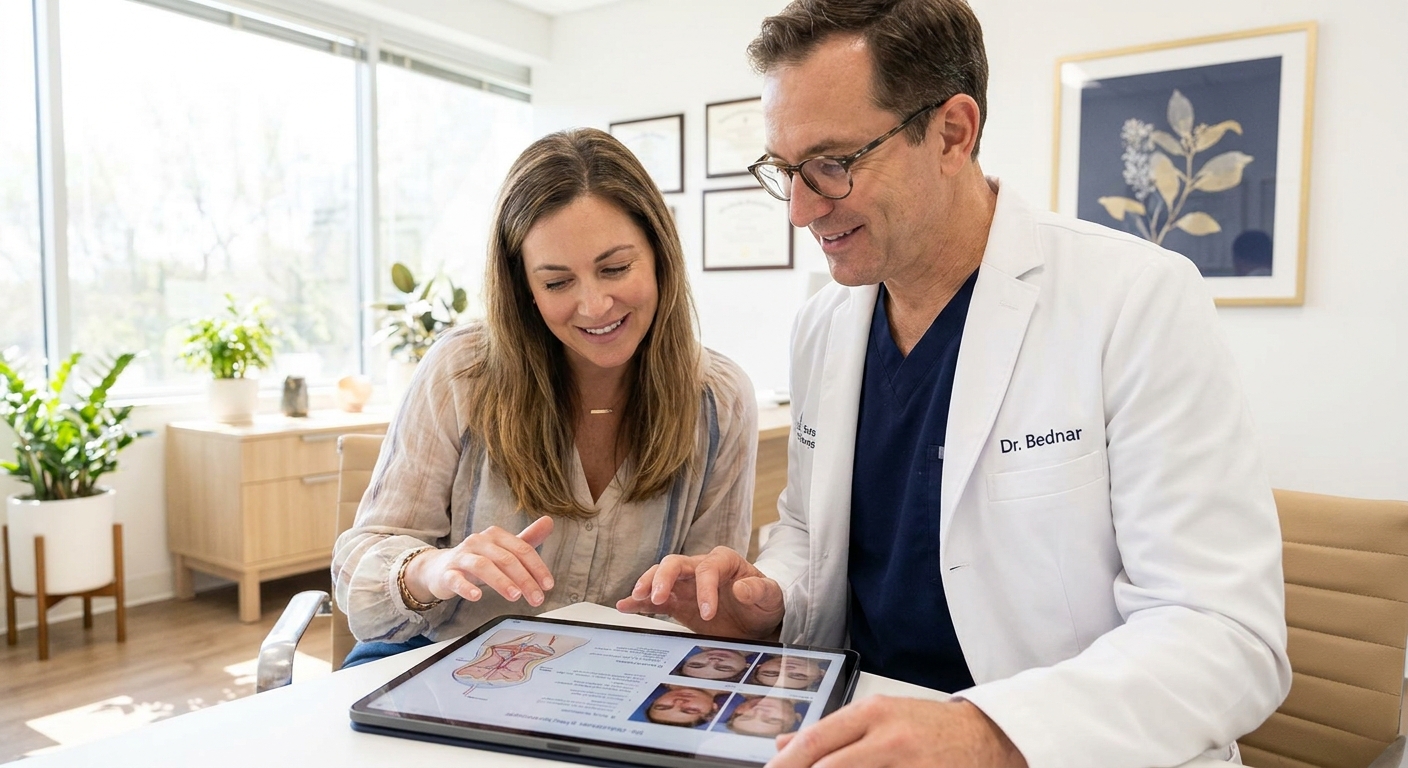
Dr. Bednar will review your medical history, prior surgeries and desired outcomes to customize your plan.
Preoperative planning
In the weeks before surgery, you’ll:
- Avoid blood-thinning medications such as aspirin and NSAIDs
- Stop smoking at least four weeks prior to improve healing
- Arrange for assistance during the first 48 hours after treatment
- Follow fasting instructions if sedation is planned
Thorough planning helps minimize complications and optimize your graft survival.
Managing your recovery
Timeline of healing
Recovery varies by treatment area and volume:
| Postoperative day | Typical findings | Patient guidance |
|---|---|---|
| 1–7 | Swelling, bruising in donor and recipient sites | Use cold compresses, gentle walking |
| 2–3 weeks | Bruising resolves, moderate swelling persists | Gradually resume light activities |
| 4–6 weeks | Most swelling subsides, early results visible | Begin low-impact exercise |
| 3–6 months | Final volume and contour established | Full return to routine |
Care guidelines
- Keep incisions clean and dry; follow your post-op dressing schedule
- Wear compression garments on donor sites for 2–4 weeks
- Sleep with treated areas elevated to reduce swelling
- Hydrate well and maintain a nutrient-dense diet for optimal healing
Activity and exercise
- Walk daily starting day one to boost circulation
- Avoid vigorous exercise for at least three weeks
- Resume full workouts only after clearance from your surgeon
When to seek care
Contact your provider if you notice:
- Signs of infection (redness, fever, discharge)
- Sudden increase in pain or swelling
- Irregular lumps or asymmetry that do not improve
Assessing risks and safety
Common side effects
Most patients experience:
- Mild bruising and swelling at harvest and injection sites
- Temporary firmness or nodules as grafts settle
- Mild discomfort managed with over-the-counter analgesics
Mitigating serious complications
Major events are rare when you choose an experienced team:
- Infection
- Fat necrosis
- Seroma or hematoma
In a study of 396 patients, 27.8% reported complications and only 10.9% were classified as major; none were life-threatening [5]. Over half of those issues resolved fully.
Clinical outcomes and statistics
- Scar severity improves by over 50% in clinical trials of scar revision grafting [2].
- 80–90% of patients report significant pain relief and satisfaction one year after treatment.
These data underscore the predictable safety profile and regenerative power of fat grafting under expert hands.
Evaluating alternative options
Comparing dermal fillers
- Hyaluronic acid fillers provide immediate results but require repeat treatments every 6–12 months
- Fat grafting yields subtle improvement over months with results lasting years
Considering implants
- Silicone or saline implants can achieve dramatic volume but carry risks of capsular contracture and implant rupture
- Autologous fat avoids foreign body complications and offers regenerative benefits
Other revision methods
- AlloClae’s alloclae body contouring solution may combine targeted liposuction with fat grafting for refined silhouette
- For facial volume loss, explore autologous facial fat restoration or precision fat grafting for volume loss
Taking the next steps
Questions for Dr. Bednar
Before your consultation, consider asking:
- How many revision sessions might I need?
- What percentage of transferred fat do you expect to survive?
- Can you show before-and-after examples of similar cases?
- How do you minimize donor-site contour irregularities?
Scheduling your consultation
To explore how fat grafting can correct your previous surgery outcomes with natural, regenerative techniques, contact AlloClae for a personalized assessment. Your journey to smoother, more harmonious contours starts with expert guidance and a tailored plan.
By choosing autologous fat transfer under Dr. Bednar’s care, you invest in a technique that blends surgical artistry with cellular rejuvenation for results that look, feel and age beautifully.