
Fat Graft Breast Before and After: Charlotte Patient Transformations
When a Charlotte patient walked into Dr. Bednar’s office with severe breast constriction and extensive scar tissue from prior surgery, the obvious choice would have been aggressive single-stage correction. Her tissue was very thin. It had been pulled tight and retracted over years of longstanding obstructive changes. Most surgeons would have tried to fix everything at once, move a large volume of fat, and hope it held.
Dr. Bednar did the opposite. He slowed the whole thing down. Instead of one big procedure, he mapped out four to six smaller fat-transfer sessions, spaced six to twelve months apart, placing only about 100 to 150 cc each time. That is roughly a quarter or less of what a standard case might use in a single sitting. The reason behind that decision is the real story here, and it explains why some of the most natural fat graft breast before and after results come from patience, not from a single dramatic operation.
If you are researching this procedure in Charlotte, you probably want two things at once. You want a fuller, more natural shape, and you want to trust that the surgeon holding the plan actually knows how fat behaves in difficult tissue. This case shows both.
Why This Charlotte Patient Chose Staged Fat Transfer Over Single-Procedure Correction
The temptation with a complex case is to solve it fast. A patient with constriction, scarring, and tissue retraction wants to see change, and a surgeon under pressure to deliver may reach for volume. But fat is a living graft. It needs a healthy blood supply to survive in its new location. When you push a large amount of fat into tight, damaged, poorly vascularized tissue, much of that fat has nowhere to plug in. It does not integrate. It gets reabsorbed, and in some cases it forms firm areas or oil cysts that complicate later work.
Dr. Bednar looked at this patient’s compromised tissue and made a clinical call. Thin skin, heavy scarring, and a retracted breast pocket cannot accept and nourish a big transfer. So the goal shifted from “how much can we place” to “how much can this tissue actually keep alive right now.” Smaller volumes, placed carefully and given time, do something a single large transfer cannot. Each session slightly improves the tissue itself. The grafted fat brings its own supply of cells that help remodel scar tissue, add pliability, and prepare the area to accept more fat next time.
Think of it like conditioning ground before planting. The first pass is modest on purpose. It expands the space, improves the quality of the tissue, and creates a better foundation. By the time the second and third sessions arrive, the breast can hold and support more fat than it could at the start. That is why staging works so well in exactly the cases where a rushed single procedure tends to disappoint. In this case, substantial improvement in tissue quality, scar remodeling, and graft take showed up within the first one to six months after each procedure, producing a safer, more durable result.
For this Charlotte patient, the staged plan turned a very difficult starting point into a durable, natural result. It also matched the practice philosophy: enhancing your natural beauty with artistry and surgical judgment, not forcing a dramatic change the body cannot support.
The Staged Approach: Session by Session, and How Much Volume Actually Stays
Here is the part most articles skip. They quote a volume number and move on. What matters with fat grafting is not how much you place, but how much survives long term, and that number is where staging earns its keep.
In Dr. Bednar’s documented experience, staging fat transfer rather than combining it with an explant or a mastopexy produces markedly better graft survival, often 40 to 50 percent greater long-term volume retention than doing both in one operation. When fat transfer is separated from explant or lift surgery, he holds a minimum of three months between stages so the tissue can settle and rebuild its blood supply before the next graft goes in.
For the constricted-breast case, the intervals were longer, six to twelve months between each of the four to six sessions. Each session placed only 100 to 150 cc. After every procedure, the tissue was reassessed before planning the next one. This is the advantage of going slow: you get to measure. Within the first one to six months after each session, there was visible improvement in tissue quality, scar remodeling, and graft take. That feedback told Dr. Bednar how much the breast could accept next time, and where.
Picture the progression. Session one softens the pocket and adds a small amount of durable volume. Six months later, the tissue is more pliable, the scar has loosened, and the breast can hold a bit more. Session two builds on ground that is now healthier than before. By the final session, the shape has filled in gradually, and because each graft integrated properly, the result stays. Compare that to a single large transfer, where half or more of the fat might reabsorb, leaving a flatter, less predictable outcome and a patient wondering why the change faded.
That is the core of a strong fat graft breast before and after story. The “after” holds up because the plan respected how fat actually survives.
What Charlotte Patients Need to Know About Fat Graft Breast Augmentation Candidacy
Fat transfer is not the right tool for every goal, and being honest about that is part of choosing the right surgeon. This procedure suits patients who want modest, natural enhancement, usually in the range of one to one-and-a-half cup sizes, rather than a large jump in size. If your goal is a dramatic increase, implants may fit that better, and Dr. Bednar will tell you so directly during your consultation.
Two things drive candidacy. First, you need adequate donor fat. The fat has to come from somewhere, usually the abdomen, flanks, or thighs, and it is harvested through liposuction. Very thin patients have less to work with, which is one reason staging matters even more for them, as it did in the case above, where a very thin patient’s limited donor supply made small, repeated sessions the safest path. According to the American Society of Plastic Surgeons, fat transfer breast augmentation depends on both available donor fat and realistic expectations about how much volume the recipient tissue can retain. Second, you need patience. This is not a one-and-done procedure for most people who want a real change. It rewards patients willing to commit to a timeline that runs over many months, sometimes more than a year for complex cases.
The trade-off is worth naming plainly. You give time, and in exchange you get results that look and feel like your own body, because they are. There is no implant to maintain and no device that ages on a separate clock from you. For patients whose deepest worry is looking overdone or obviously done, the natural feel of your own tissue is exactly the reassurance they are searching for.
A good candidate, then, is someone with enough donor fat, a goal of subtle enhancement, and the willingness to follow a staged plan. During a Charlotte consultation, Dr. Bednar evaluates all three so you know before you commit whether the results you want are realistic for your body. Reviewing fat graft breast before and after images together at this stage helps set those expectations honestly.
Recovery Timeline and What to Expect After Each Fat Transfer Session
Recovery after fat graft breast augmentation is generally less restrictive than recovery from implant surgery, and that surprises a lot of patients in a good way. There is no large implant pocket to heal around and no device settling into place. Instead, you have two areas to care for: the donor site where fat was removed, and the breast where it was placed.
Most of the early discomfort comes from the liposuction, not the breast. The donor areas feel sore, bruised, and tight for the first week or two, similar to a hard workout that will not quit. You will likely wear a compression garment on the donor site to help the area settle and to support healing. The breasts themselves usually feel tender and swollen but are rarely the main source of soreness. Many patients return to desk work within several days to a week, depending on how much liposuction was done and how they feel.
The part that takes real commitment is not any single recovery. It is the string of them. Because the best results come from staging, a Charlotte patient plans for multiple sessions over months, each with its own short recovery. This is where being local pays off. Scheduling sessions six to twelve months apart, driving in for follow-ups, and having your surgeon reassess your tissue in person between stages is far easier when the practice is in your city rather than across the country. You are not booking flights and hotels around each phase. You are building a relationship with one surgeon who tracks your progress over time.
One honest caution: protect the grafted fat during healing. Pressure and sustained compression on the breasts in the early weeks can hurt graft survival, so Dr. Bednar will give you specific guidance on sleeping position, bras, and activity after each session. Following that guidance closely is part of why the volume stays.
Why Charlotte Patients Choose Fat Transfer Over Implants
Many patients who consult Dr. Bednar about fat grafting arrive after a hard experience with implants, or after reading enough about them to feel uneasy. The U.S. Food and Drug Administration has documented that breast implants are not lifetime devices and that risks include rupture, capsular contracture, the need for additional surgeries, and rare associated conditions. That reality pushes a lot of people to look for an alternative that uses their own tissue instead of a device.
Fat transfer answers that worry directly. The material is you. There is nothing synthetic to rupture, no capsule to harden, and no scheduled replacement down the road. The feel is soft and natural because it is your own fat integrated into your own breast. For patients whose biggest fear is looking or feeling artificial, that difference is the whole point. It also fits a growing group in Charlotte seeking implant removal who want to restore some shape and volume after explant, using staged fat transfer to rebuild in a way that lasts. Because keeping the transfer separate from the explant preserves 40 to 50 percent more volume long term, that staged rebuild is not just safer, it holds far better.
There is a bonus most patients appreciate. Because the fat is harvested through liposuction, you also slim the donor area. Reshaping the waist, flanks, or thighs while adding modest breast volume gives a contour improvement that a device alone cannot. That is body contouring and enhancement working together, which suits the practice’s artistic approach to the whole silhouette rather than one isolated feature.
None of this makes fat transfer automatically better than implants for everyone. It makes it the better fit for a specific patient: someone who values natural tissue, modest enhancement, and freedom from a maintenance device, and who is willing to trade a longer timeline for a result grown from their own body.
Scheduling Your Fat Graft Breast Consultation in Charlotte
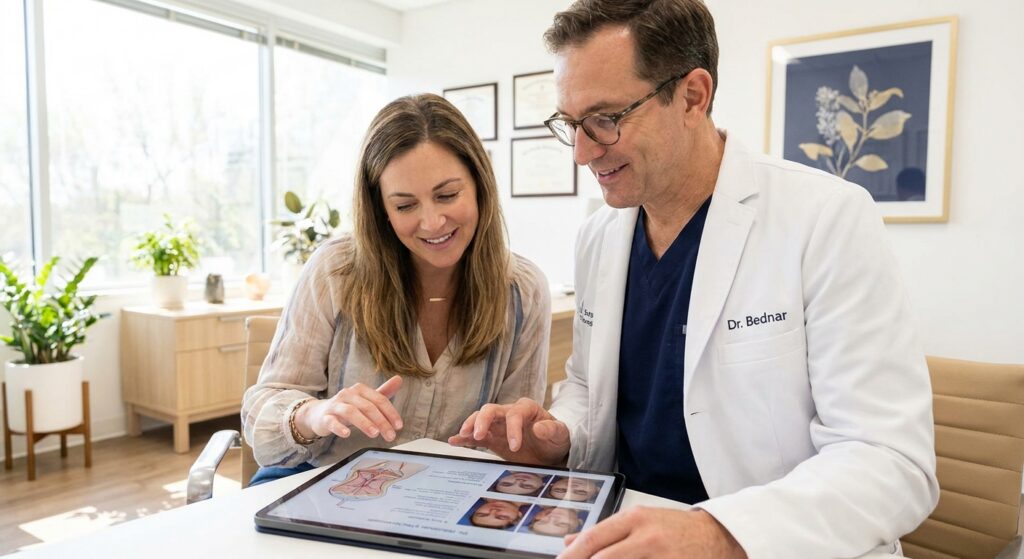
The consultation is where the plan becomes real and personal. Dr. Bednar does not apply a template. He evaluates your specific tissue quality, checks whether you have enough donor fat and where it can safely come from, and talks through what a staged timeline would actually look like for your goals. If your tissue is compromised by prior surgery, scarring, or constriction, he will explain why smaller volumes over more sessions protect your result rather than rushing it.
You will also get an honest read on expectations. If one to one-and-a-half cup sizes of natural enhancement matches what you want, fat transfer may be an excellent path. If your goals point elsewhere, he will say so. This straight-talking, personalized, patient-centric approach is the reason cautious patients trust him with something this personal. You leave the consultation knowing your candidacy, your realistic outcome, and the number of stages likely involved, before you commit to anything. Ask to review fat graft breast before and after outcomes during your visit so you can see how staged results progress over time, keeping in mind that individual results vary.
Schedule a consultation with Dr. Bednar in Charlotte to discuss your fat graft breast augmentation candidacy, review before-and-after outcomes, and develop a personalized staging plan. Call (704) 366-6700.
Frequently Asked Questions
How much volume can I expect from each fat transfer session?
Volume per session depends on your tissue quality. In complex cases with scarring or constriction, Dr. Bednar may place only 100 to 150 cc per session, roughly a quarter or less of a standard case, to protect graft survival. In ideal candidates with healthy, pliable tissue, sessions can range higher, around 300 to 400 cc. Staging across sessions optimizes how much fat survives long term.
How long do I wait between fat graft breast sessions?
Dr. Bednar generally spaces sessions six to twelve months apart. That interval lets each graft fully integrate, gives the tissue time to improve, and allows him to assess quality before planning the next session. When fat transfer follows an explant or lift, he holds a minimum of three months between stages.
Can I combine fat transfer with breast implant removal?
It is usually better to stage them. In Dr. Bednar’s documented outcomes, keeping fat transfer separate from explant or mastopexy surgery produces 40 to 50 percent better long-term volume retention than combining both in one operation. The tissue needs time to recover its blood supply before it can support and keep new fat.
What size increase is realistic with fat graft breast augmentation?
Most patients achieve about one to one-and-a-half cup sizes through staged fat transfer. The exact result depends on how much donor fat you have and the quality of your breast tissue. Fat grafting suits modest, natural enhancement rather than a large jump in size. Individual results vary.
How do I know if I am a candidate for fat transfer breast augmentation?
Strong candidates have enough donor fat to harvest, want natural, modest enhancement, and can commit to a staged timeline for the best volume retention. During your Charlotte consultation, Dr. Bednar assesses your donor fat, tissue quality, and goals to tell you honestly whether the result you want is realistic.