

How aging affects fat grafting results is one of the most important questions to ask before a procedure, and one of the least straightforward to answer. The grafted fat becomes living tissue, which means it responds to your biology over time, not just in the weeks after surgery. Understanding that relationship changes how you think about results, maintenance, and realistic expectations.
What Fat Grafting Actually Does Over Time
Fat grafting works by harvesting fat cells from one area of your body, typically the abdomen, flanks, or thighs, and transferring them to restore volume where aging has caused depletion. In the face, that usually means the cheeks, temples, and under-eye hollows. Once transferred, surviving fat cells integrate into the surrounding tissue, develop a blood supply, and behave exactly like the native fat that was already there.
That last part is the key to understanding long-term results. The transplanted fat does not exist in a preserved state. It participates fully in your body’s ongoing biological processes, including the hormonal shifts, metabolic changes, and tissue aging that affect all soft tissue over time. Results are long-lasting, but not fixed. They evolve with you.
Why Aging Affects Grafted Fat Differently Than You Expect
Most patients assume that grafted fat either survives or it doesn’t. The reality is more nuanced. A 2021 study published in Plastic and Reconstructive Surgery examining fat cell biology found that transplanted adipocytes that successfully integrate into host tissue respond to systemic hormonal and metabolic signals in the same way native fat cells do. This includes sensitivity to weight changes, estrogen fluctuations, and the gradual reduction in growth factor activity that comes with biological aging.
What this means in practice: the fat that survives and integrates is not inert. It shrinks when you lose weight, responds to hormonal changes after menopause, and sits within a skin envelope that continues to thin and lose elasticity over time. Understanding what drives longevity in transferred fat before your procedure helps you go in with accurate expectations, not optimistic ones.
The Survival Window That Determines Long-Term Results
The first three to six months after fat grafting are the period that determines your long-term volume. During this window, the body reabsorbs a portion of the transferred fat as cells that failed to establish blood supply are cleared. A 2018 meta-analysis published in Aesthetic Surgery Journal, analyzing outcomes across 23 studies with more than 1,100 patients, found average graft retention rates of 55 to 80 percent depending on technique, placement depth, and recipient site vascularity.
The volume you see at six months is the volume that stays. Not the volume at six weeks, which is still affected by swelling and partial resorption. Six months is your true baseline. Schedule any formal results assessment at that point, and use those photos as your reference going forward.
How Skin Laxity Compounds Changes After 40
The grafted fat does not exist in isolation. It sits beneath skin that has its own aging trajectory. A 2019 study in the Journal of Investigative Dermatology, tracking dermal collagen density across age groups, found that collagen production declines by approximately 1 percent per year after age 20, with measurable acceleration in the perimenopausal decade.
After 40, that collagen loss becomes visible as skin thinning, reduced elasticity, and the gradual loosening of the skin envelope over deeper structures. Even when grafted fat volume remains intact, a looser overlying skin layer changes how that volume appears. The fill and the envelope both matter. Pairing your fat grafting with long-term skin care support addresses both layers of the aging equation rather than treating them as separate problems.
What Results Typically Look Like at the Five-Year Mark
At five years, most patients retain meaningful volume in the areas treated. A 2016 long-term outcomes study published in JAMA Facial Plastic Surgery, following 67 facial fat grafting patients over a minimum of five years, found that the majority maintained noticeable volume improvement relative to pre-procedure baseline, though all experienced some degree of ongoing facial aging in the surrounding tissue.
The result at five years looks natural precisely because the grafted fat has aged with you. The goal was never to freeze a moment in time. It was to restore youthful proportion, and proportion holds up well even as time continues. The patients whose results look best at five years are those whose surrounding tissue has been maintained, not just the grafted volume itself.
Volume That Tends to Hold
Deeper structural zones hold grafted fat most reliably. The mid-cheek, malar eminence, and temporal hollows show consistently higher long-term retention compared to more superficial areas like the tear trough or the fine lines around the lips. This is because deeper placement provides better vascular access for graft integration and less mechanical disruption from facial movement.
Ask your surgeon at consultation which zones in your face have the strongest graft survival track record, and weight your expectations accordingly. Results in high-mobility areas or very superficial planes require more realistic expectations about longevity.
Changes That Are Normal, Not Failures
Mild contour irregularities and subtle asymmetry at the five-year mark are predictable biological outcomes, not signs that something went wrong. A 2020 study in Aesthetic Plastic Surgery tracking 89 fat grafting patients through significant body weight changes found that grafted fat responds proportionally to systemic fat mass shifts, with each 10-pound change in body weight producing measurable volume changes in treated areas.
If your weight fluctuates, your results will reflect that. How weight changes move grafted fat follows the same logic as native fat: the cells expand and contract with your metabolic state. Maintaining stable body weight is the single most controllable factor in preserving long-term outcomes.
How Age at the Time of Procedure Influences Outcomes
A 2018 study published in Dermatology Times, examining fat grafting outcomes across age-stratified groups, found that patients over 55 showed measurably lower graft survival rates compared to patients in their 30s and 40s. The mechanism is vascular: younger tissue recruits blood supply to transplanted fat cells more efficiently. Reduced vascularity and lower growth factor activity in older tissue slows integration and increases early resorption.
This is not an argument for indefinite delay. Earlier treatment, when tissue quality and vascularity are stronger, produces better graft survival and longer-lasting results. The takeaway is to discuss timing directly with a board-certified surgeon rather than waiting until volume loss is severe. The biology favors acting before tissue quality has declined significantly.
Fat Grafting vs. Dermal Fillers: Which Holds Up Better Over Time
A 2019 comparative outcomes study published in Aesthetic Surgery Journal, following patients treated with either hyaluronic acid fillers or fat grafting at matched facial sites, found that filler patients showed significant volume loss by 12 to 18 months while fat grafting patients retained volume through the 36-month endpoint with no additional treatment.
Fillers dissolve. Fat integrates. For patients whose primary concern is maintenance cost and repeat treatment frequency, the durability case for fat transfer is grounded in biology, not marketing. Ask your provider to run a side-by-side cost-over-time comparison at your consultation. The upfront investment in fat grafting often looks different when measured against years of filler maintenance.
The Lifestyle Factors That Protect Your Results
A 2021 cohort study in Plastic and Reconstructive Surgery, following 212 patients over three years, identified four variables with statistically significant associations with long-term graft retention: weight stability, UV protection, skin care quality, and overall metabolic health. Each maps directly to a biological mechanism. Weight fluctuation contracts and expands fat cells. UV exposure degrades the collagen and elastin that form the structural matrix around grafted tissue. Metabolic dysfunction reduces the vascular and hormonal environment that supports long-term fat cell viability.
Of these, weight stability carries the strongest evidence for direct graft preservation. The rest matter, but they matter most when weight is already controlled. Building habits that protect your results over the long term means starting with the variable that has the most biological leverage.
When a Touch-Up Makes Sense
Secondary fat grafting is a normal part of long-term outcome management, not a sign that the original procedure failed. A 2017 study in Clinics in Plastic Surgery, reviewing re-grafting outcomes in facial patients, found that secondary procedures in well-integrated tissue produced graft survival rates comparable to primary grafting, with patients reporting high satisfaction at 24-month follow-up.
The right indicators for a touch-up include significant volume loss following a major weight change, asymmetry that is noticeable at rest, or aging in the surrounding tissue that has outpaced the grafted area. If results have shifted noticeably and it has been more than two years since your original procedure, a consultation to assess current volume distribution is the right move.
What to Do This Week
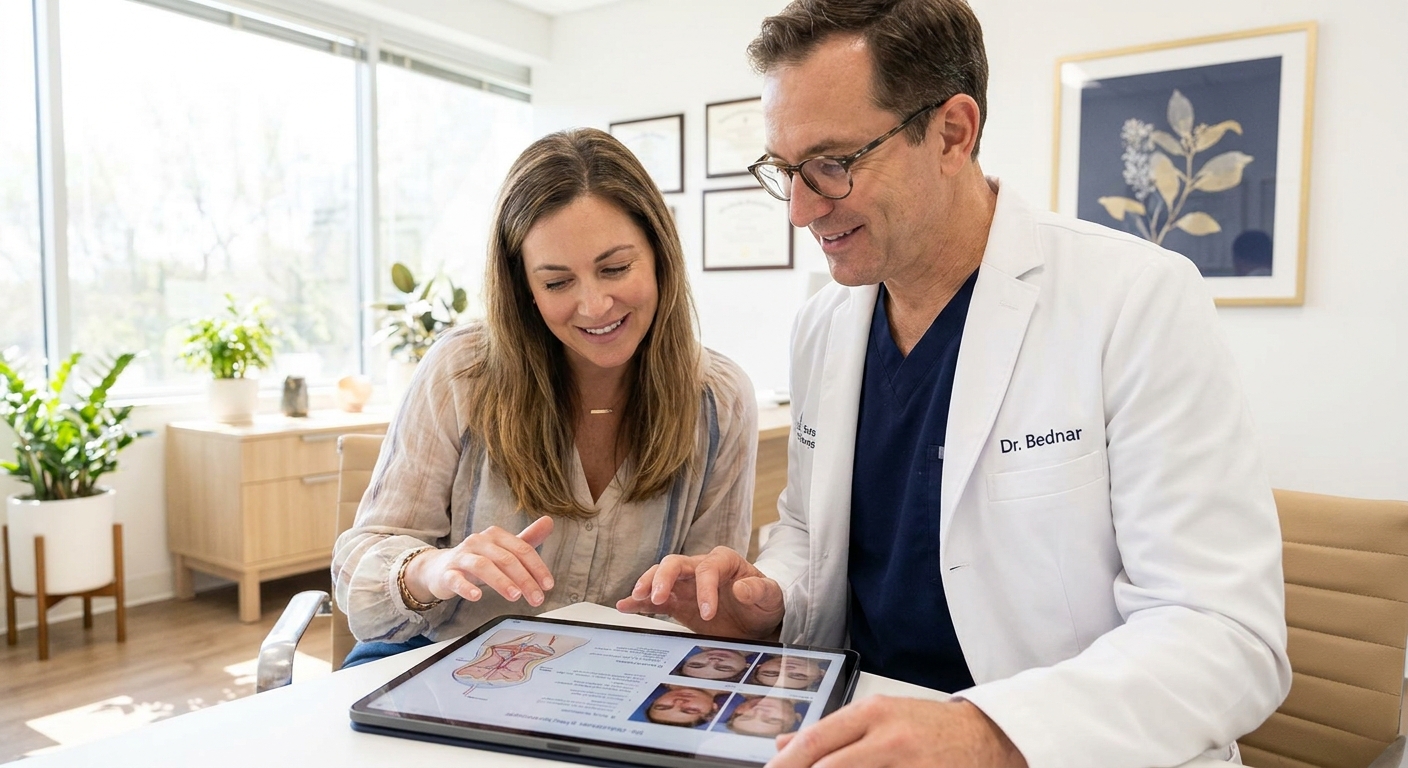
Book a consultation and bring two sets of photos: images taken immediately post-procedure (or as close to six months after as you have) and current photos taken in consistent lighting. That comparison gives a surgeon the most useful data for assessing what has changed and what options fit your current timeline. Everything else follows from that conversation.