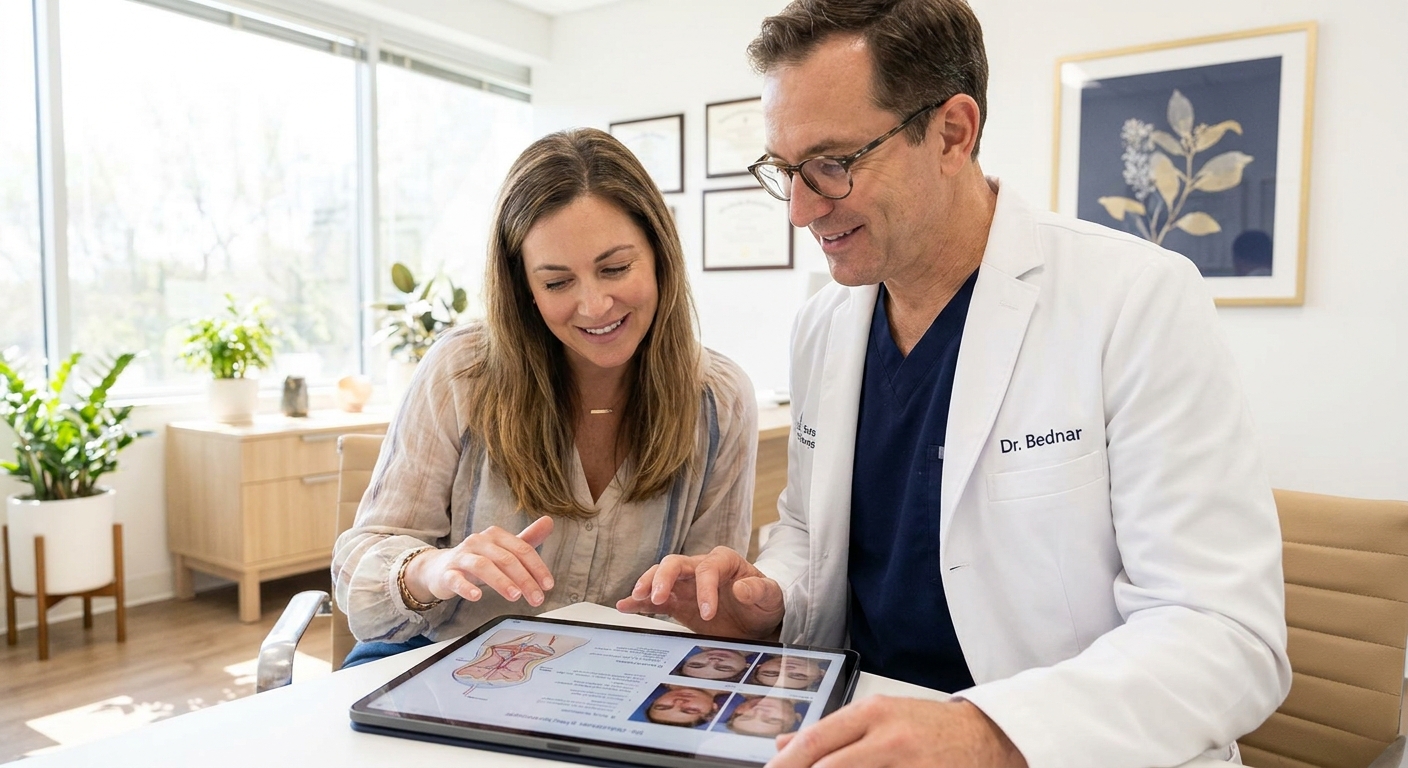

You’re exploring breast lift with fat transfer support as a natural way to restore shape and volume without implants. In this procedure, your surgeon performs a mastopexy to lift and support sagging tissue, then harvests your own fat via liposuction and injects it into targeted areas for subtle augmentation and contouring [1]. Combining these techniques offers regenerative benefits, symmetry correction, and minimal scarring.
Throughout this guide you’ll learn how the procedure works, whether you’re a good candidate, what to expect during recovery, and how to compare alternatives like implant-free breast rejuvenation or fat transfer for breast reconstruction.
Understand the procedure
Breast lift basics
A breast lift, or mastopexy, repositions and supports breast tissue to correct sagging. Incisions vary by lift amount—periareolar for minor lifts, “lollipop” for moderate correction, and “anchor” for significant repositioning [2]. Your nipple and areola remain attached to underlying tissue to preserve sensation and milk ducts.
Fat transfer fundamentals
Fat transfer uses liposuction to remove excess fat from donor sites such as the abdomen, thighs, or flanks, purifies the cells, then injects them into your breasts. Because you’re using your own tissue, you avoid implant-related risks like allergic reactions or breast implant illness [3]. The result is a natural feel, subtle volume increase, and improved donor-site contour.
Combined benefits
By pairing a lift with fat grafting you achieve dual benefits in one surgery—lifting sagging tissue while adding volume. This regenerative approach promotes cell viability and tissue health. Fat grafting can also address asymmetry through targeted injections [4], and refine contours without implants [5].
Assess your candidacy
Ideal candidate profile
You’re a good candidate if you:
- Have mild to moderate breast sagging and desire subtle volume enhancement
- Maintain a stable weight and have enough donor fat for grafting [1]
- Are non-smoker or willing to quit pre- and post-surgery to optimize healing
- Are in good overall health without uncontrolled conditions like diabetes or cardiovascular disease
Factors to consider
Consider these factors when planning your procedure:
- Body mass index: extremes of weight limit graft volume and survival rates
- Prior breast surgeries: scar tissue can affect lift technique and fat retention
- Lifestyle: commitment to post-op care, support garments, and activity restrictions
Explore combined techniques
Incision options
Your surgeon selects an incision based on lift degree:
- Periareolar (“donut”): small lifts, incision around the areola
- Circumvertical (“lollipop”): moderate lifts, incision from areola to breast crease
- Inverted T (“anchor”): major lifts, adds horizontal crease incision
Fat grafting steps
- Harvest: Liposuction removes fat from abdomen, thighs, or flanks
- Process: Centrifugation isolates viable fat cells
- Inject: Microdroplet technique places fat into breast tissue for optimal survival
Regenerative benefits
Fat transfer is not just volume—it delivers stem cells and growth factors that support tissue health. You may experience improved skin quality and scar softening, a principle used in scar revision using fat grafting. For more holistic contouring, explore the regenerative breast contour procedure.
Targeted symmetry
Precise fat placement corrects asymmetry, ideal when combined with lift for balanced results.
Contour without implants
Fat grafting refines upper-pole fullness and smooths transitions, minimizing abrupt implant edges.
Know potential risks
A combined lift and fat grafting procedure carries low complication rates, but you should be aware of both minor and rare risks.
Common minor complications
- Palpable cysts (2.0%): often aspirated in the office
- Oil cysts (6.5%): benign imaging findings
- Calcifications (4.5%): may require follow-up with additional imaging
Rare major complications
According to a systematic review of 22 studies (2,073 patients), major complications were uncommon [6]:
- Hematoma: 0.5%
- Infection: 0.6%
- Seroma: 0.1%
Imaging considerations
Fat grafting can introduce microcalcifications visible on mammograms, leading to a 16.4% chance of additional imaging and a 3.2% chance of biopsy referral to rule out malignancy [6]. Routine screening remains effective, but you should inform your radiologist about your procedure.
| Complication | Incidence (%) | Management |
|---|---|---|
| Hematoma | 0.5 | Drainage if needed |
| Infection | 0.6 | Antibiotics |
| Seroma | 0.1 | Aspiration |
| Palpable cysts | 2.0 | Office aspiration (67%) |
| Oil cysts | 6.5 | Observation |
| Calcifications | 4.5 | Imaging follow-up |
| Fat necrosis | 1.2 | Monitoring or excision |
| Radiologic referral | 16.4 | Additional scans or biopsy |
Plan your recovery process
Postoperative care
- Wear an elastic bandage and surgical bra day and night for six weeks [1]
- Use cold compresses to reduce bruising and swelling
- Follow incision care instructions to minimize scarring
Activity restrictions
- Avoid exercise and strenuous activities for four to six weeks [7]
- Sleep on your back for two weeks to protect grafted areas
- Gradually resume daily activities after one week off work
Follow-up imaging
Schedule your first post-op mammogram after three months, informing your radiologist of fat grafting to interpret any changes accurately.
Evaluate expected outcomes
Timeline for results
- Immediate: noticeable lift and volume, plus early swelling
- Six weeks: most swelling subsides, begin to see shape
- Six months: final volume as fat cells settle permanently
Longevity of results
Once fat cells establish a blood supply, results are long-lasting. Some cells may reabsorb—studies show 40 to 60 percent retention—so more fat may be injected upfront to compensate [8].
Aesthetic improvements
- Natural feel and movement, difficult to distinguish from native tissue [3]
- Improved upper-pole fullness and roundness
- Enhanced donor-site contour through liposuction
Consider alternate options
If you’re exploring other implant-free solutions or need specialized restoration, review these procedures:
- Implant-free breast rejuvenation for lift without implants implant-free breast rejuvenation
- Autologous volume boost augmentation with autologous fat
- Fat transfer for symmetry in reconstruction fat transfer for breast reconstruction
- Natural enhancement after pregnancy natural enhancement after pregnancy
- Volume restoration without implants volume restoration with natural fat
- Post-mastectomy contouring fat transfer for post-mastectomy recovery
Each approach leverages your own fat to achieve regenerative contouring, whether correcting asymmetry, revising scars, or restoring feminine shape. By understanding your options, you can make an informed choice that aligns with your goals for natural, long-lasting results.